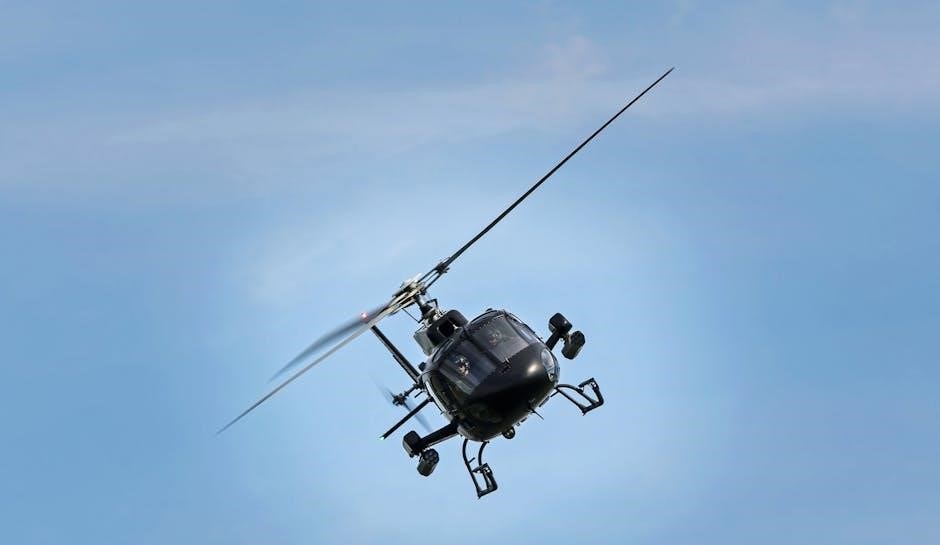
sky rover helicopter instructions
Sky Rover Helicopter Instructions: A Comprehensive Guide
Welcome! This guide provides detailed instructions for your Sky Rover RC Helicopter, covering everything from unboxing to advanced flight techniques.
Explore the manual available on Amazon, or access FCC ID VVA85714000001 details for comprehensive support. Enjoy stable, easy control with turbo speed boost!
Understanding Your Sky Rover Helicopter
Congratulations on acquiring a Sky Rover RC Helicopter! This aircraft, like the King and Knightforce models (858952, 858922), is designed for both indoor and outdoor flight, offering a stable and enjoyable experience.
It operates on a 2.4 GHz radio control system, ensuring reliable communication with the transmitter. Familiarize yourself with the 3.0 channel functionality for precise control. The Sky Rover boasts a turbo speed boost feature for enhanced performance.
Before your first flight, understand that proper care and adherence to the instructions are crucial for safe operation and longevity. This helicopter requires careful handling and regular maintenance, as detailed in the user manual.
Unboxing and Component Overview
Carefully open the Sky Rover helicopter package. You should find the fully assembled helicopter unit, a separate transmitter (radio controller), and potentially a USB charging cable. Some models may include spare rotor blades – retain these for future replacement.
Inspect all components for any visible damage sustained during shipping. The helicopter itself features the main rotor, tail rotor, landing skids, and the battery compartment. The transmitter will have control sticks and buttons for throttle, rudder, and elevator control.
Refer to the user manual (available on Amazon) for a detailed diagram identifying each component. Ensure all listed parts are present before proceeding. A quick unboxing video is also available online for visual guidance.
Safety Precautions Before First Flight
Prioritize safety! Always fly your Sky Rover helicopter in a large, open area, free from obstacles like trees, power lines, and buildings. Keep a safe distance from people and pets – at least 20 feet is recommended.
Never operate the helicopter in inclement weather conditions, such as rain or strong winds. Regularly inspect the rotor blades for cracks or damage; do not fly with damaged blades. Ensure the transmitter batteries are fully charged to prevent loss of control during flight.
Keep these instructions handy for future reference. Understand the transmitter controls before attempting flight. Adult supervision is strongly advised for younger users. Familiarize yourself with the helicopter’s behavior before attempting advanced maneuvers.
Charging the Helicopter Battery
Proper charging is crucial for optimal performance and battery longevity. Option A involves connecting the helicopter directly to the USB charger, then plugging the USB into a computer or compatible electronic device. Remember to disconnect the charging station once the battery is fully charged to prevent overcharging.
Charging times vary, but typically range from 30 to 60 minutes. A red indicator light usually signifies charging is in progress, while a green light indicates a full charge. Avoid using chargers other than the one supplied with your Sky Rover helicopter.
Always monitor the battery during charging. Do not leave the helicopter unattended while charging.
Installing Batteries in the Transmitter
Powering your transmitter is a simple process. Locate the battery compartment, typically on the underside of the transmitter. Open the compartment cover – it usually slides or has a small latch. Insert the required number of batteries, paying close attention to the polarity markings (+ and -) inside the compartment.
Typically, the Sky Rover transmitter requires AA batteries, but confirm the specific type in your manual. Ensure the batteries are inserted correctly for proper contact. Close the battery compartment cover securely. Incorrect battery installation can prevent the transmitter from functioning.
Test the transmitter’s power by observing the indicator light or screen activation.

Transmitter Controls and Functions

Understanding your transmitter is crucial for successful flight. The transmitter features several key controls for maneuvering your Sky Rover helicopter. Familiarize yourself with each function before attempting flight. The primary controls include the throttle, rudder, and elevator.
The transmitter operates on a 2.4 GHz frequency, ensuring stable control. Precise adjustments to these controls dictate the helicopter’s movement. Practice coordinating these controls in a safe, open area. Remember to consult the manual for a detailed diagram of the transmitter layout and specific control mappings.
Mastering these controls will unlock the full potential of your Sky Rover experience.
Throttle Control
Throttle control manages the helicopter’s rotor speed, directly impacting altitude. Pushing the throttle lever upwards increases rotor speed, causing the helicopter to ascend. Conversely, lowering the lever decreases speed, resulting in descent.
Smooth, gradual adjustments are key to stable flight. Avoid abrupt throttle changes, as these can lead to instability; When the helicopter flies steadily, slowly push the throttle lever up for ascent. Practice maintaining a consistent hover by making small throttle corrections.
Refer to the manual for specific throttle curves and sensitivity settings. Careful throttle management is fundamental to controlled flight with your Sky Rover.
Rudder Control
Rudder control governs the helicopter’s yaw – its rotation around its vertical axis. Moving the rudder stick left causes the helicopter to rotate counter-clockwise, while moving it right initiates clockwise rotation.
Precise rudder adjustments are crucial for maintaining heading and executing coordinated turns. Use subtle inputs to avoid overcorrecting and causing unwanted oscillations. Mastering rudder control allows for precise positioning and controlled maneuvers.
The Sky Rover’s responsiveness to rudder input may vary; practice in an open space. Consult the manual for optimal rudder settings and sensitivity adjustments. Consistent practice builds the muscle memory needed for effective yaw control.
Elevator Control
Elevator control manages the helicopter’s pitch – its movement up and down. Pushing the elevator stick forward causes the nose to lower, initiating a descent. Pulling the stick back raises the nose, resulting in an ascent.
Smooth and deliberate elevator inputs are essential for stable climbs and descents. Avoid abrupt movements, as they can lead to stalls or loss of control. Coordinate elevator adjustments with throttle control for controlled vertical maneuvers.
The Sky Rover’s elevator responsiveness requires practice. Refer to the manual for fine-tuning sensitivity. Mastering elevator control is key to achieving stable flight and precise altitude adjustments.
Pre-Flight Check List
Before each flight, a thorough pre-flight check is crucial for safety and optimal performance. First, inspect the rotor blades for any cracks or damage. Second, ensure the battery is fully charged, following the charging instructions carefully.
Third, verify that all screws and components are securely fastened. Fourth, confirm the transmitter batteries are fresh and functioning correctly. Fifth, check the linkage between the transmitter and helicopter.

Finally, perform a range test to ensure a strong signal. Refer to the Sky Rover manual for detailed guidance. A diligent pre-flight routine minimizes risks and maximizes your flying enjoyment.
Basic Flight Operations
Mastering basic flight operations requires patience and practice. Begin in a spacious, open area, free from obstacles; First, gently increase throttle to initiate takeoff, maintaining a stable hover. Second, practice hovering, using small rudder and elevator adjustments for control.
Third, attempt slow forward and backward flight, coordinating throttle and pitch. Remember, smooth control inputs are key to stable flight. Fourth, gradually increase speed as your confidence grows.
Finally, always maintain visual contact with your Sky Rover Helicopter. Refer to the manual for detailed instructions and safety guidelines. Consistent practice will build your skills and enhance your flying experience.
Takeoff Procedures
Initiating takeoff with your Sky Rover Helicopter requires a delicate touch. Ensure the helicopter is placed on a level surface, away from obstructions. Gently increase the throttle, observing the main rotor’s response. As the rotor speed increases, the helicopter will begin to lift.
Maintain a steady hand and avoid abrupt throttle movements. Once airborne, use the rudder to counteract any unwanted rotation. Slowly elevate the helicopter to a safe hovering altitude. Remember, smooth and controlled throttle application is crucial for a successful takeoff.
Refer to the user manual for specific guidance related to your Sky Rover model. Practice these steps in an open area for optimal results.
Hovering Techniques
Achieving a stable hover with your Sky Rover Helicopter is fundamental to mastering flight. Begin by gently adjusting the throttle to maintain a consistent altitude. Simultaneously, use the rudder control to counteract any yawing or spinning motion.
Small, precise corrections are key; avoid overcorrecting. The elevator control can be used for minor pitch adjustments, keeping the helicopter level. Practice maintaining a stationary position, focusing on smooth and coordinated control inputs.
Remember, consistent practice is essential. Refer to the manual for model-specific nuances. A steady hand and patient approach will yield successful hovering results with your Sky Rover.
Forward and Backward Flight
Initiating forward flight with your Sky Rover Helicopter requires a gentle push of the elevator control. Combine this with a slight increase in throttle to maintain altitude and momentum. Avoid abrupt movements, as this can lead to instability.
For backward flight, gently pull back on the elevator control while maintaining throttle. Coordinate rudder inputs to counteract any unwanted rotation. Remember to practice in an open area, allowing ample space for maneuvering.
Smooth and controlled movements are crucial for successful forward and backward flight. Consult your manual for specific recommendations and practice consistently to refine your technique.
Troubleshooting Common Issues
Encountering problems with your Sky Rover Helicopter? Several common issues can arise. If the helicopter isn’t responding, first check the transmitter batteries and ensure it’s properly bound to the receiver. Verify the power switch is on, and the charging connection is secure.
Unstable flight often indicates improper trimming or wind interference. Adjust the trim controls on the transmitter for optimal stability. If charging proves problematic, ensure the USB connection is firm and the charging station is functioning correctly.
Refer to the manual for detailed troubleshooting steps and FCC ID VVA85714000001 resources. Remember safety first!
Helicopter Not Responding
If your Sky Rover Helicopter fails to respond to transmitter commands, begin with a thorough check of the transmitter’s batteries. Ensure they are fresh and correctly installed. Next, verify the binding process between the transmitter and the helicopter receiver has been successfully completed.
Confirm the power switch on both the transmitter and helicopter are in the ‘on’ position. Inspect the charging cable and connection for any damage or loose connections. A disconnected or faulty charging cable can prevent power-up.
Consult the user manual for specific binding instructions and troubleshooting tips related to FCC ID VVA85714000001.
Unstable Flight
Experiencing unstable flight with your Sky Rover Helicopter? First, check the rotor blades for any signs of damage – cracks, bends, or imbalances. Even minor damage can significantly affect flight stability. Ensure the blades are securely attached according to the manual.
Calibrate the gyro system as described in the user manual; this is crucial for maintaining a stable hover. Wind conditions can also contribute to instability, so attempt flight in a calm, indoor environment initially.
Verify proper battery charge; low battery levels can lead to erratic behavior. Refer to the FCC ID VVA85714000001 documentation for optimal performance guidelines and troubleshooting.
Charging Problems
Encountering issues charging your Sky Rover Helicopter? Begin by verifying the USB cable and adapter are functioning correctly with another device. Option A involves directly connecting the helicopter to the USB charger, then plugging it into a computer or electronic device.
Ensure a secure connection between the charging cable and both the helicopter and the power source. If charging fails, disconnect the charging station immediately to prevent potential damage. Consult the user manual for specific charging times and indicators.
Refer to FCC ID VVA85714000001 documentation for troubleshooting steps. A faulty battery may also be the cause; consider replacement if issues persist.

Maintenance and Care
Regular maintenance ensures optimal performance and longevity of your Sky Rover Helicopter. After each flight, inspect the rotor blades for any signs of damage, such as cracks or bends. Clean the helicopter with a soft, dry cloth to remove dust and debris.
Keep the battery charged and stored in a cool, dry place when not in use. Avoid exposing the helicopter to extreme temperatures or direct sunlight. Periodically check the screws and fasteners to ensure they are tight.
Refer to the user manual for detailed cleaning and storage guidelines. Proper care, as outlined in FCC ID VVA85714000001 documentation, will maximize your flying experience.
Replacing Rotor Blades

Damaged rotor blades significantly impact flight stability; replacement is crucial for safe operation. Begin by disconnecting the helicopter’s battery to prevent accidental activation. Carefully remove the old blades, noting their specific orientation – upper and lower blades differ.
Align the new blades correctly, ensuring a secure fit onto the rotor shaft. Tighten the screws firmly, but avoid over-tightening, which could cause damage; Double-check that both blades are securely attached and balanced.
Consult the Sky Rover manual (available on Amazon) for detailed diagrams and instructions specific to your model. Proper blade replacement, as detailed in FCC ID VVA85714000001 documentation, is vital for continued safe flight.
Advanced Flight Techniques (Optional)
Experienced pilots can explore advanced maneuvers after mastering basic flight. Attempting figure eights and loops requires precise control and ample open space. Practice smooth transitions between forward flight and hovering for enhanced agility.
Controlled rolls and flips demand quick reflexes and a thorough understanding of the helicopter’s responsiveness. Utilize the rudder and elevator controls in coordination with the throttle for complex movements. Remember, these techniques increase the risk of crashes.
Refer to online resources and the Sky Rover manual (found on Amazon) for guidance. FCC ID VVA85714000001 documentation doesn’t detail these, so proceed cautiously and prioritize safety during advanced practice.
Finding the Official Manual Online
Locating the official Sky Rover Helicopter manual is straightforward. Many users report finding it readily available on Amazon, often accessible for download without requiring a purchase of the product itself. This provides convenient access to detailed instructions and troubleshooting guidance.
Alternatively, you can explore the FCC ID database using VVA85714000001. While the FCC filings contain user manual details, they may not offer the same user-friendly format as the Amazon version. Searching online retailers and the ALPHA GROUP website may also yield results.
Ensure you download the manual specific to your Sky Rover model (e.g., King, Knightforce) for accurate instructions. Referencing the correct documentation is crucial for safe and enjoyable operation.
FCC ID Information (VVA85714000001)
The Sky Rover RC Helicopter is registered with the Federal Communications Commission (FCC) under the ID VVA85714000001. This identification number is assigned to devices that transmit radio frequency signals, ensuring they meet FCC regulations for interference.

Accessing information related to this FCC ID can provide technical details about the helicopter’s transmitter and compliance testing. You can search the FCC database using this ID to view documentation submitted by Guangdong Alpha Animation and Culture Co., Ltd., the manufacturer.
This documentation includes the user manual, though it may be a more technical version than the consumer-facing guide. The FCC ID confirms the helicopter has been evaluated for electromagnetic compatibility and safety standards.